
,fit=pad/contentassets/8c25a81873f3447490ffdc9d9b53f5f5/kito_black.png)
,fit=pad/contentassets/df70ce6ebb1e45bda867f458ffed9e71/harrington_color-logo_light-background_crop.png)
,fit=pad/globalassets/logos/stahl/new-by-cmco/stahl_color-10.11.svg)
,fit=pad/globalassets/logos/yale/new/yale-10.11.svg)
,fit=pad/contentassets/1f4eac3541654db5a396d6c67f7ce0fb/crosby_red_rgb.png)
,fit=pad/contentassets/aa99b2f703284295af4814e40a22bbfc/gunnebo-industries_color-logo_crop.png)
,fit=pad/contentassets/5cd5182b5c724d6199ff77c450920a56/eepos-logo2025_eeblue_crop.png)
,fit=pad/globalassets/logos/magnetek/new/magnetek_wide_color-10.11.svg)
,fit=pad/globalassets/logos/dorner/new/dorner_color-10.11.svg)
,fit=pad/globalassets/logos/montrac/montrac-logo.png)
,fit=pad/globalassets/logos/pfaff/pfaff_color_cmyk_new.png)
,fit=pad/globalassets/logos/duff-norton/new/duff-norton_color-10.11.svg)
,fit=pad/globalassets/logos/garvey/new/garvey_color-10.11.svg)
,fit=pad/contentassets/1be5ec1cbb8e442392f10efd8b5b95a0/2-peerless_color-logo_light-background-crop.png)
,fit=pad/globalassets/logos/cm/new/cm_color-10.11.svg)
,fit=pad/globalassets/logos/acco_color-logo.png)
,fit=pad/globalassets/logos/shaw-box/new/shaw-box_color-10.11.svg)
,fit=pad/globalassets/logos/unified/new/unified_color-10.11.svg)
,fit=pad/globalassets/logos/little-mule/new/little_mule_color-10.11.svg)
,fit=pad/contentassets/b2b82ee821bd43ababced737cb426315/erikkila-only_color-logo_all-black_crop.png)
,fit=pad/globalassets/logos/steerman/new/steerman_color-10.11.svg)
,fit=pad/globalassets/logos/dixie/new/dixie_industries_color-10.11.svg)
,fit=pad/globalassets/brand-landing-pages/airpes/crosby-airpes-logo-2023-tall-web.png)
,fit=pad/globalassets/brand-landing-pages/van-leusden/van-leusden-logo.png)
,fit=pad/globalassets/logos/camlok/new/camlok-10.11.svg)
,fit=pad/globalassets/logos/nutting_color-logo.png)
,fit=pad/globalassets/logos/speedbinders/speedbinders_color-logo.png)
,fit=pad/globalassets/logos/scc/scc-logo3.png)
 North America - EN
,fit=pad/contentassets/8c25a81873f3447490ffdc9d9b53f5f5/kito_black.png)
,fit=pad/contentassets/df70ce6ebb1e45bda867f458ffed9e71/harrington_color-logo_light-background_crop.png)
,fit=pad/globalassets/logos/stahl/new-by-cmco/stahl_color-10.11.svg)
,fit=pad/globalassets/logos/yale/new/yale-10.11.svg)
,fit=pad/contentassets/1f4eac3541654db5a396d6c67f7ce0fb/crosby_red_rgb.png)
,fit=pad/contentassets/aa99b2f703284295af4814e40a22bbfc/gunnebo-industries_color-logo_crop.png)
,fit=pad/contentassets/5cd5182b5c724d6199ff77c450920a56/eepos-logo2025_eeblue_crop.png)
,fit=pad/globalassets/logos/magnetek/new/magnetek_wide_color-10.11.svg)
,fit=pad/globalassets/logos/dorner/new/dorner_color-10.11.svg)
,fit=pad/globalassets/logos/montrac/montrac-logo.png)
,fit=pad/globalassets/logos/pfaff/pfaff_color_cmyk_new.png)
,fit=pad/globalassets/logos/duff-norton/new/duff-norton_color-10.11.svg)
,fit=pad/globalassets/logos/garvey/new/garvey_color-10.11.svg)
,fit=pad/contentassets/1be5ec1cbb8e442392f10efd8b5b95a0/2-peerless_color-logo_light-background-crop.png)
,fit=pad/globalassets/logos/cm/new/cm_color-10.11.svg)
,fit=pad/globalassets/logos/acco_color-logo.png)
,fit=pad/globalassets/logos/shaw-box/new/shaw-box_color-10.11.svg)
,fit=pad/globalassets/logos/unified/new/unified_color-10.11.svg)
,fit=pad/globalassets/logos/little-mule/new/little_mule_color-10.11.svg)
,fit=pad/contentassets/b2b82ee821bd43ababced737cb426315/erikkila-only_color-logo_all-black_crop.png)
,fit=pad/globalassets/logos/steerman/new/steerman_color-10.11.svg)
,fit=pad/globalassets/logos/dixie/new/dixie_industries_color-10.11.svg)
,fit=pad/globalassets/brand-landing-pages/airpes/crosby-airpes-logo-2023-tall-web.png)
,fit=pad/globalassets/brand-landing-pages/van-leusden/van-leusden-logo.png)
,fit=pad/globalassets/logos/camlok/new/camlok-10.11.svg)
,fit=pad/globalassets/logos/nutting_color-logo.png)
,fit=pad/globalassets/logos/speedbinders/speedbinders_color-logo.png)
,fit=pad/globalassets/logos/scc/scc-logo3.png)
,fit=cover/contentassets/8670a852bce74c7b8b4f9fc87544f46b/2024_01-22_longview-29.jpg)
Not All Lifting Equipment Is Created Equal: Why Manufacturing Integration Defines Rigging Safety
Rigging | By Columbus McKinnon | Jun 24, 2026
A Global Lifting Awareness Day 2026 perspective on the supply chain behind every shackle, hook, and link, and the questions every rigging buyer should be asking before the load goes up.
Two shackles on a distributor’s shelf can look identical, carry the same working load limit, and bear branding that suggests equivalence; they are not necessarily the same product. The name on a piece of rigging hardware says nothing, on its own, about who forged the steel, who heat treated it, who proof tested it, or who is accountable when the load is finally applied in the field.
This is the question at the heart of Global Lifting Awareness Day 2026: not only how to rig safely, but how to make informed decisions about the hardware doing the lifting before it ever reaches the jobsite. The answer comes down to one factor that rarely appears on a bid sheet, and it is the factor that determines whether every other rating on that sheet can be trusted: manufacturing integration.
The Visibility Problem in Rigging Hardware
Every rigging manufacturer is expected to meet performance ratings and government safety regulations; many do, and some do not. In a global supply chain where private labeling is common practice, the visual sameness of finished products is precisely what makes the question so difficult to answer at the point of purchase.
Hardware reaches a distributor through one of two supply chain models: one is controlled from raw material to finished good by a single manufacturer, while the other passes through multiple suppliers with private branding applied at the end. The hardware may look the same on the shelf, but what is inside the steel, and who is accountable for it, is very different.
A brand on a shackle does not automatically mean that brand made the shackle, because not all branded products are manufactured by the brand owner. In an outsourced model, a rigging company can put its name on hardware that was forged, heat-treated, and finished by an outside supplier the buyer never sees, with the brand owner effectively functioning as a labeler rather than a manufacturer. The further down that chain a piece of hardware travels, the harder it becomes to answer simple questions about where the steel came from, how it was treated, and who stands behind it when something goes wrong.
Two Supply Chain Models, Two Standards of Accountability
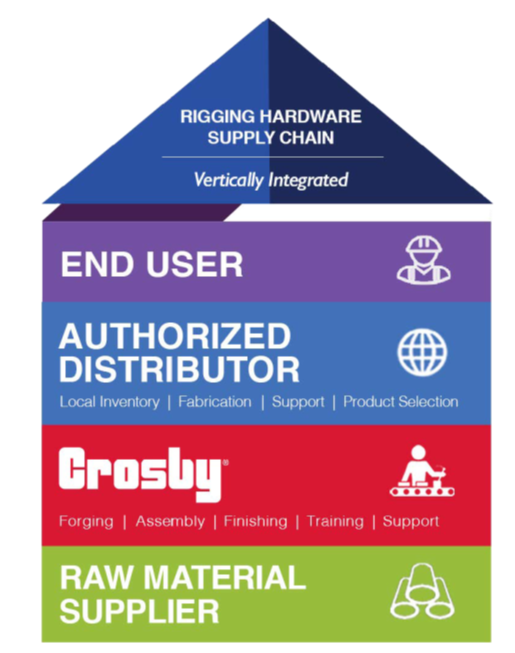
The vertically integrated model
A vertically integrated supply chain gives a single manufacturer control of the entire production process from raw material to finished goods, with that control enabling product inspection at multiple stages of production and driving consistent quality across product lines. It also keeps internal engineering, product innovation, and new product R&D under one roof, where the people designing the hardware are the same people running the manufacturing line and watching how it performs in the field.
Characteristics of a vertically integrated supply chain include:
- Control over the supply chain and the quality of the raw material source
- Internal engineering, product innovation, and new product R&D
- A single-source manufacturer with control of product scheduling and the manufacturing process
- Responsibility for quality and safety carried by a single owner
- A protected distribution network and the fewest handoffs to the end user
- The highest level of accountability when questions arise in the field
The outsourced or non-integrated model
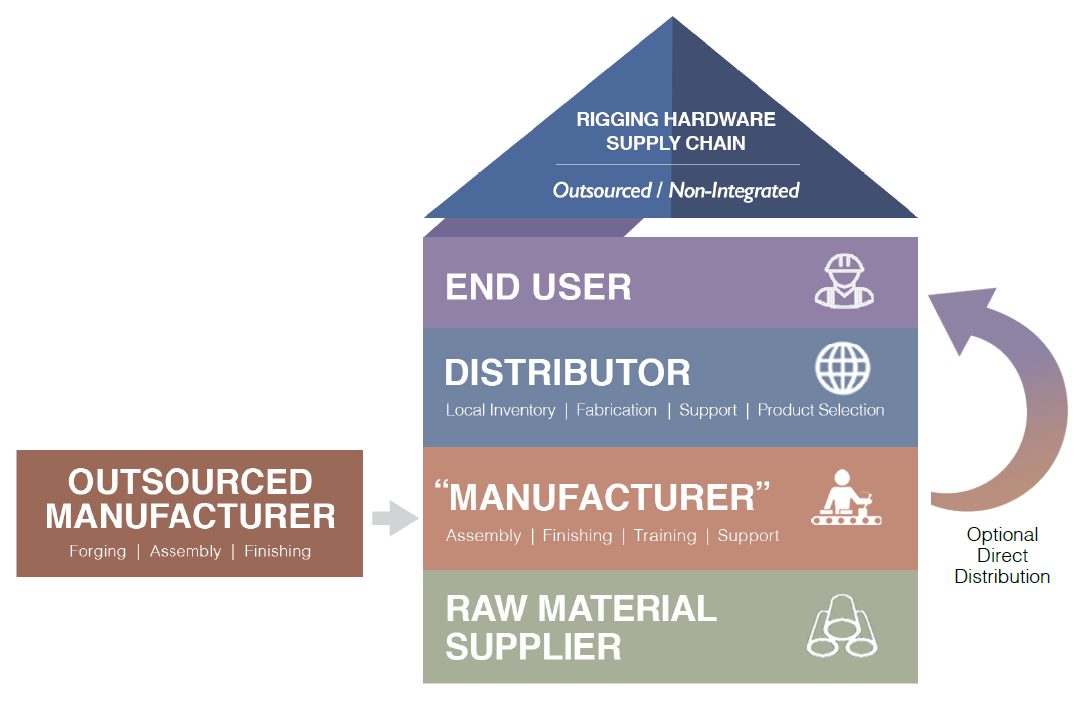
An outsourced supply chain has limited control over the manufacturing process, including inspections and raw material quality, and a single product can pass through multiple manufacturers before it is ready for sale. Each handoff introduces a new variable, and each variable is a place where consistency can quietly erode without anyone in the chain owning the result.
Characteristics of an outsourced or non-integrated supply chain could include:
- Unknown quality of raw material source and lack of traceability
- Multiple manufacturing processes and standards, with unclear ownership of quality and safety
- Off-the-shelf private branded products and a lack of product life cycle commitment
- Limited scheduling and manufacturing controls
- Lack of a protected distribution network, with direct-to-customer sales
- Loss of quality control review and limited accountability
Neither model is invisible to a buyer; both leave a paper trail. The question is whether anyone asks for it.
Four Questions Every Rigging Buyer Should Ask
Cost and lead time get asked on every rigging order; manufacturing accountability often does not, because buyers assume the brand on the hardware answers that question when, in practice, it cannot. The following four questions will tell a buyer more about a rigging supplier than any spec sheet.
- Are material certifications complete and transparent, showing the mill and country of origin of the steel used? Buy only from a manufacturer that documents both raw material and finished good country of origin, along with the other elements required by local and federal standards. If the paperwork stops at the brand label, the answer is incomplete.
- Are third party material test certificates available, and whose name is on them? Certificates should let a buyer trace the material back to the original producer of the raw material, so the buyer knows who is manufacturing the material used in the rigging equipment going into service. If other third party manufacturers appear on the certificate, that supply chain deserves additional research and due diligence before the product is used.
- What percent of the supplier’s products are re-sold or partially assembled? A buyer should know whether they are working with a vertically integrated manufacturer or a so-called manufacturer that private labels from an outsourced source. Uppermost in any purchasing decision should be safety, because every lift is critical, and the wrong choice can both put a company in jeopardy and result in serious injury or death of employees in the field.
- Does the manufacturer offer proof loading services? A buyer should expect hardware rated to withstand a proof load higher than the WLL dictated by application and hardware type. Proof loading is an important means of verifying the hardware's performance and ensuring defective products do not get to the field. The manufacturer should offer proof loading of their hardware and certificates as evidence the load was applied. This can take the form of statistical sampling, individual proof loading, or load to order.
What Buyers Get When They Choose Crosby
A vertically integrated supply chain
Proven drop forge process
Advanced heat treatment
 , and Cold Tuff methods. This results in hardware that meets load ratings, resists fracture, and performs even in extreme conditions, including sub-zero environments.
Verified performance
Traceability and risk management
Comprehensive product line
Engineering and support
Training and field resources
Global distribution network
Industry leadership and digital access
Why This Matters for Global Lifting Awareness Day 2026
Global Lifting Awareness Day exists to raise the level of conversation about safe lifting practices worldwide, and most of that conversation focuses on the people performing the lift: planning, rigging, qualifications, inspection. Those things matter, but safety also lives upstream, in decisions made long before any rigger touches a piece of hardware.
Choosing a vertically integrated manufacturer is one of the most consequential decisions a buyer can make on behalf of the people who will use the equipment in the field, and it is also one of the easiest to skip, because the bid sheet does not have a line for it and the PO does not ask the question. Three questions in a conversation with a supplier can change that.
Not all lifting equipment is created equal. For Global Lifting Awareness Day 2026, that is the conversation worth having.
Learn More
To learn more about Crosby’s vertically integrated manufacturing model and what it means for safer lifting, visit kitocrosby.com/crosby or contact your local Crosby sales manager.