,fit=pad/globalassets/logos/camlok/new/camlok-10.11.svg)
,fit=pad/globalassets/logos/cm/new/cm_color-10.11.svg)
,fit=pad/contentassets/1f4eac3541654db5a396d6c67f7ce0fb/crosby_red_rgb.png)
,fit=pad/globalassets/logos/dixie/new/dixie_industries_color-10.11.svg)
,fit=pad/globalassets/logos/dorner/new/dorner_color-10.11.svg)
,fit=pad/globalassets/logos/duff-norton/new/duff-norton_color-10.11.svg)
,fit=pad/contentassets/5cd5182b5c724d6199ff77c450920a56/eepos-logo2025_eeblue_crop.png)
,fit=pad/globalassets/logos/garvey/new/garvey_color-10.11.svg)
,fit=pad/contentassets/aa99b2f703284295af4814e40a22bbfc/gunnebo-industries_color-logo_crop.png)
,fit=pad/contentassets/df70ce6ebb1e45bda867f458ffed9e71/harrington_color-logo_light-background_crop.png)
,fit=pad/contentassets/8c25a81873f3447490ffdc9d9b53f5f5/kito_black.png)
,fit=pad/globalassets/logos/little-mule/new/little_mule_color-10.11.svg)
,fit=pad/globalassets/logos/magnetek/new/magnetek_wide_color-10.11.svg)
,fit=pad/globalassets/brand-landing-pages/montratec/2025_montratec_logo.png)
,fit=pad/contentassets/1be5ec1cbb8e442392f10efd8b5b95a0/2-peerless_color-logo_light-background-crop.png)
,fit=pad/globalassets/logos/pfaff/new/pfaff_color-10.11.svg)
,fit=pad/globalassets/logos/shaw-box/new/shaw-box_color-10.11.svg)
,fit=pad/globalassets/logos/stahl/new-by-cmco/stahl_color-10.11.svg)
,fit=pad/globalassets/logos/steerman/new/steerman_color-10.11.svg)
,fit=pad/globalassets/logos/unified/new/unified_color-10.11.svg)
,fit=pad/globalassets/logos/yale/new/yale-10.11.svg)
,fit=pad/globalassets/logos/budgit/new/budgit_hoists_color.png)
,fit=pad/globalassets/logos/chester/new/chester_hoist-10.11.svg)
,fit=pad/globalassets/logos/cm-et/cmet-color.svg)
,fit=pad/globalassets/logos/coffing/coffing-logo.png)
 North America - EN
,fit=pad/globalassets/logos/camlok/new/camlok-10.11.svg)
,fit=pad/globalassets/logos/cm/new/cm_color-10.11.svg)
,fit=pad/contentassets/1f4eac3541654db5a396d6c67f7ce0fb/crosby_red_rgb.png)
,fit=pad/globalassets/logos/dixie/new/dixie_industries_color-10.11.svg)
,fit=pad/globalassets/logos/dorner/new/dorner_color-10.11.svg)
,fit=pad/globalassets/logos/duff-norton/new/duff-norton_color-10.11.svg)
,fit=pad/contentassets/5cd5182b5c724d6199ff77c450920a56/eepos-logo2025_eeblue_crop.png)
,fit=pad/globalassets/logos/garvey/new/garvey_color-10.11.svg)
,fit=pad/contentassets/aa99b2f703284295af4814e40a22bbfc/gunnebo-industries_color-logo_crop.png)
,fit=pad/contentassets/df70ce6ebb1e45bda867f458ffed9e71/harrington_color-logo_light-background_crop.png)
,fit=pad/contentassets/8c25a81873f3447490ffdc9d9b53f5f5/kito_black.png)
,fit=pad/globalassets/logos/little-mule/new/little_mule_color-10.11.svg)
,fit=pad/globalassets/logos/magnetek/new/magnetek_wide_color-10.11.svg)
,fit=pad/globalassets/brand-landing-pages/montratec/2025_montratec_logo.png)
,fit=pad/contentassets/1be5ec1cbb8e442392f10efd8b5b95a0/2-peerless_color-logo_light-background-crop.png)
,fit=pad/globalassets/logos/pfaff/new/pfaff_color-10.11.svg)
,fit=pad/globalassets/logos/shaw-box/new/shaw-box_color-10.11.svg)
,fit=pad/globalassets/logos/stahl/new-by-cmco/stahl_color-10.11.svg)
,fit=pad/globalassets/logos/steerman/new/steerman_color-10.11.svg)
,fit=pad/globalassets/logos/unified/new/unified_color-10.11.svg)
,fit=pad/globalassets/logos/yale/new/yale-10.11.svg)
,fit=pad/globalassets/logos/budgit/new/budgit_hoists_color.png)
,fit=pad/globalassets/logos/chester/new/chester_hoist-10.11.svg)
,fit=pad/globalassets/logos/cm-et/cmet-color.svg)
,fit=pad/globalassets/logos/coffing/coffing-logo.png)
,fit=cover/globalassets/industries/metals-production/shutterstock_1019087455.jpg)
Eliminating Downtime in Metals Manufacturing
From Reactive to Predictive: How Columbus McKinnon Keeps Metals Operations Running With Intelligent Motion
By Columbus McKinnon | Apr 13, 2026
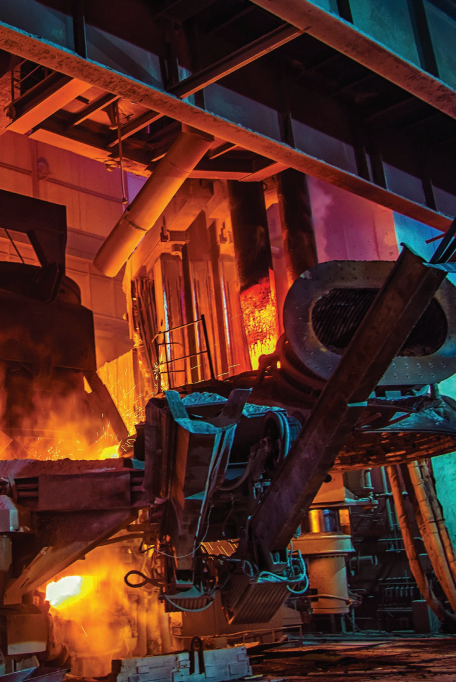
In a metals manufacturing facility, downtime rarely starts with a dramatic failure.
It starts small.
A magnet runs hotter than normal.
A brake doesn’t respond the way it should.
A crane bridge drifts under uneven load.
A delayed coil placement slows the line.
However, small issues don’t stay small for long. Furnaces run on schedules. Rolling lines depend on steady flow. Casting requires timing. When motion systems fall out of rhythm, production follows.
For years, many facilities have relied on reactive maintenance — fixing problems after equipment failed. Today, that approach carries greater operational risk and higher cost.
Across North America, steel and metals manufacturers are shifting toward predictive strategies built on visibility, coordinated control, and engineered reliability. Intelligent motion systems are central to that shift.
Explore how Columbus McKinnon supports metals operations from scrap handling to finished product.
Explore Our Metals Industry Solutions
Why Downtime Becomes a System-Level Risk
Material handling in metals manufacturing operates under demanding conditions:
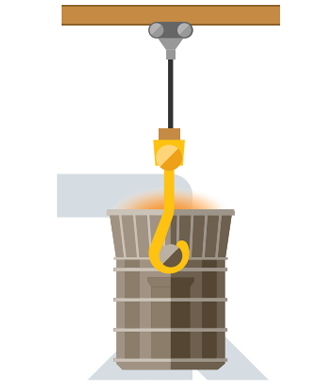
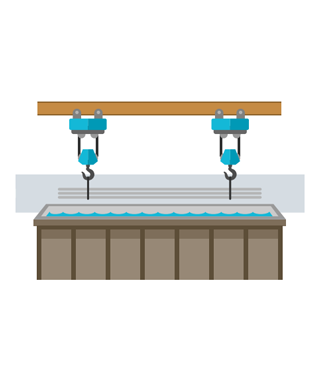
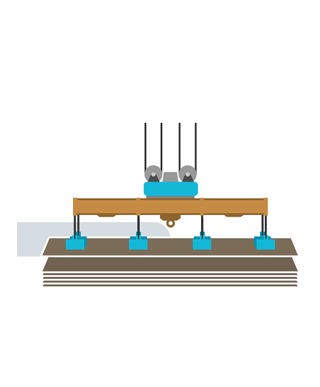
In these environments, faults rarely remain isolated. A crane issue in the melt shop can delay refining. A coil handling interruption can back up inspection and shipping. A brake anomaly during ladle transfer affects safety as much as throughput.
As production demands rise and maintenance teams stretch thinner, facilities focused on improving overall equipment effectiveness (OEE) are rethinking how motion systems are managed across the plant.
Reactive vs. Predictive Maintenance in Metals Manufacturing
Reactive maintenance responds after something fails. Production stops, maintenance intervenes, and the line resumes, often behind schedule and at a significant cost due to downtime.
Predictive maintenance takes a different approach. It uses diagnostic tools and operating data to identify irregular patterns before they lead to failure.
In metal processing material handling systems, this often begins with drive support and diagnostic tools. These systems record alarm history, log fault events, and provide performance data that maintenance teams can review to spot trends early.
Instead of reacting to unexpected shutdowns, facilities can plan service around scheduled downtime.
The move from reactive to predictive is less about new technology and more about visibility—understanding how equipment behaves before it becomes a problem.
Intelligent Motion as an Integrated Downtime Strategy
Reducing downtime requires more than durable equipment. It requires systems that work together and respond consistently under load.
Columbus McKinnon integrates lifting equipment, motion control, automation, and diagnostics across the metals production lifecycle. These systems are designed to operate as a coordinated solution rather than a collection of individual components.
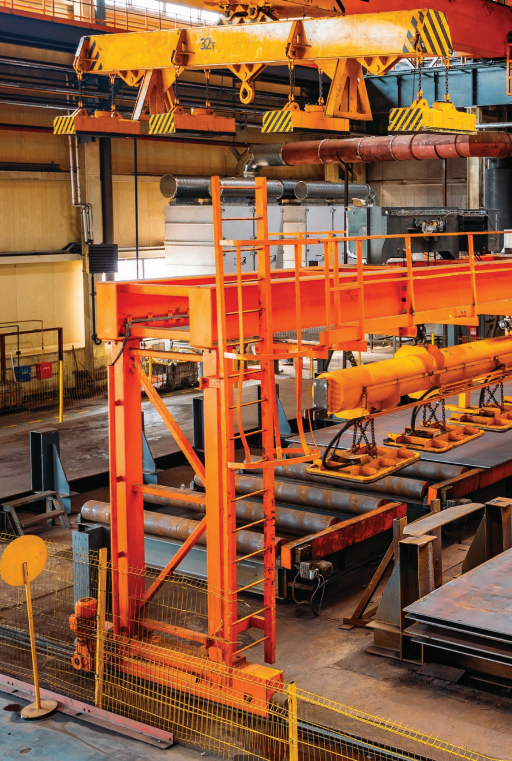
That integration can include lifting equipment and motion technologies designed to work together across crane systems:
- Yale® electric wire rope hoists integrated with crane control systems
- Powered chain hoists for accurate, incremental lifting in tasks such as assembly work or parts positioning
- Flexible, portable manual hoists for environments where electrical power is not permitted
- Variable frequency drives engineered for crane and hoist applications
- Sway control and anti-skew protection for stable load handling
- Collision avoidance systems for shared crane bays
- Drive Support & Diagnostic Tools for alarm history and performance visibility
- AC line regenerative systems that return braking energy to the facility power supply
- Engineered below-the-hook lifting devices for application-specific loads
- Mobile workstation cranes for predictable, repeatable material handling
Each component addresses a specific challenge. Working together, they support more consistent operation across the production cycle.
Download the Steelmaking Solutions Brochure to review application-specific capabilities in detail.
Scrap Handling: Addressing Risk Early
Predictive thinking often begins in the scrap yard.
Magnet cranes operate at high cycle rates and frequently share operating space. Overheating, inconsistent magnet performance, or crane interference can gradually lead to interruption.
DC motor and magnet controls regulate current draw to help manage thermal stress. Monitoring systems track variables such as temperature and operating performance. Power-loss ride-through capability helps maintain magnet energization during brief interruptions.
Collision avoidance systems assist in managing crane spacing.
When scrap handling remains stable, the rest of the process benefits.
Furnace Loading and Melt Shop Operations: Maintaining Control Under Extreme Conditions
In the melt shop, crane performance directly affects furnace timing. High temperatures and continuous duty cycles place constant stress on equipment, leaving little room for variation.
Variable frequency drives regulate acceleration and deceleration, helping reduce mechanical stress during heavy-load cycles. Braking systems provide consistent stopping reliability in steel mill environments. AC line regenerative systems are able to return braking energy to the facility power supply, improving overall system efficiency.
To support maintenance planning, Intelli-Connect™ Mobile provides analytical and diagnostic capabilities without requiring entry into high-temperature areas. This visibility allows maintenance teams to identify issues early and plan service without interrupting production.
Ladle Transfer and Secondary Steelmaking: Coordinating Critical Movement
Transporting molten metal requires coordination across crane motion, load stability, and operator awareness.
Magnetek motion control technologies support that coordination. Sway control reduces pendulum movement during travel, while anti-skew protection helps maintain bridge alignment under uneven loading conditions. Intelli-Lift™ load monitoring systems, for example, can detect off-center picks or side pulls before they place excess strain on crane components.
Automation solutions such as Intelli-Guide™ positioning and no-fly zone programming help standardize crane movement and prevent travel into restricted areas. Combined with collision avoidance systems, these technologies support safer handling and more consistent process timing.
Casting, Rolling, and Product Handling
In continuous casting, screw jacks and linear actuators provide accurate positioning of mold and guide components. Rotary unions maintain coolant flow through rotating equipment.
In rolling operations, consistent positioning is critical to maintaining product quality and keeping production on schedule. Duff-Norton screw jacks and linear actuators provide controlled, repeatable motion for applications such as roll adjustment and positioning.
These systems are designed for high-load, high-duty-cycle environments. By maintaining alignment and reducing variation during processing, they help minimize rework and avoid disruptions that can slow the entire line.
Downstream, coil handling solutions and plate handling equipment play a direct role in maintaining both product quality and production flow. Yale electric wire rope hoists paired with engineered coil grabs support controlled lifting and placement, reducing the risk of coil damage during transfer.
Stable, repeatable handling helps prevent product defects that can lead to rework or delays. When handling remains consistent, inspection, packaging, and shipping processes continue without interruption, preventing localized issues from turning into broader downtime.
In fabrication environments, workstation cranes support efficient material movement. Sheet metal handling systems, bar and tube handling equipment, and heavy fabricated component lifting solutions address a wide range of part sizes and weights.
Across these applications, coordinated motion and system visibility help limit unexpected interruption.
Looking for application-specific lifting solutions? Contact Our Metals Industry Specialists
Visibility and Standardization
A predictive strategy depends on access to system information.
Intelli-Connect™ Mobile and Drive Support & Diagnostic Tools provide access to alarm history, fault logs, and performance data that maintenance teams can review to identify developing concerns. These tools allow operators to monitor crane performance and troubleshoot issues without direct interaction with equipment in hazardous areas.
For facilities utilizing Unified® crane systems, ProPath™ control solutions support consistent and repeatable crane movement across operators and shifts. These systems help standardize lifting operations by enabling defined travel paths and positioning behavior, reducing variability in how materials are moved throughout the facility.
Standardized motion profiles reduce mechanical strain and contribute to more predictable system performance.
When motion systems are integrated and monitored together, uptime becomes something that can be managed proactively as part of daily operations.
Frequently Asked Questions
-
How can metals manufacturers reduce unplanned downtime?
By integrating lifting solutions, motion control technologies, and diagnostics into a coordinated system. Monitoring tools help identify irregular performance early, while features like sway control and collision avoidance reduce mechanical stress.
-
What is predictive maintenance in steel manufacturing?
It uses diagnostic data, such as alarm history, hoist life, and operating trends, to identify developing issues before equipment failure interrupts production.
-
What equipment is used for steel coil handling?
Steel coil handling solutions typically include engineered coil grabs paired with wire rope hoists equipped with variable frequency drive control for secure engagement and controlled placement.
-
How do overhead crane systems support uptime?
Crane systems equipped with power and motion control products, like variable frequency drives, braking systems, sway control, and diagnostic tools, to support controlled motion and provide maintenance visibility across the production cycle.
-
What are common material handling challenges in metals facilities?
Extreme heat, heavy loads, shared crane bays, and precise positioning requirements all create operational pressure. Integrated lifting and motion control systems are designed to address these conditions.
-
How does OEE relate to motion control?
OEE reflects availability, performance, and quality. When motion systems operate predictably and are supported by diagnostic insight, unplanned downtime decreases and production stability improves.
From Maintenance Response to Operational Control
Downtime cannot be completely eliminated in heavy industrial environments. Equipment operates under sustained stress, and maintenance will always be required.
Unplanned interruption, however, can be reduced and better managed through integration, visibility, and disciplined motion control.
Columbus McKinnon supports this shift through coordinated lifting, motion control, and diagnostic systems engineered for the full metals production lifecycle, from scrap handling and furnace loading to casting, rolling, and fabrication.
Ready to move from reactive maintenance to
greater operational control?